The Future of Digital Marketing in India: What Business Owners Need to Know for 2026 and Beyond
Digital marketing in India has changed more in the past five years than in the two decades before that combined. What worked in 2020 — basic Facebook boosting, generic SEO keyword stuffing, cookie-cutter websites — is already obsolete. Business owners who are still operating with a 2020 mindset about digital marketing are falling behind competitors who have adapted to where the industry is actually heading.
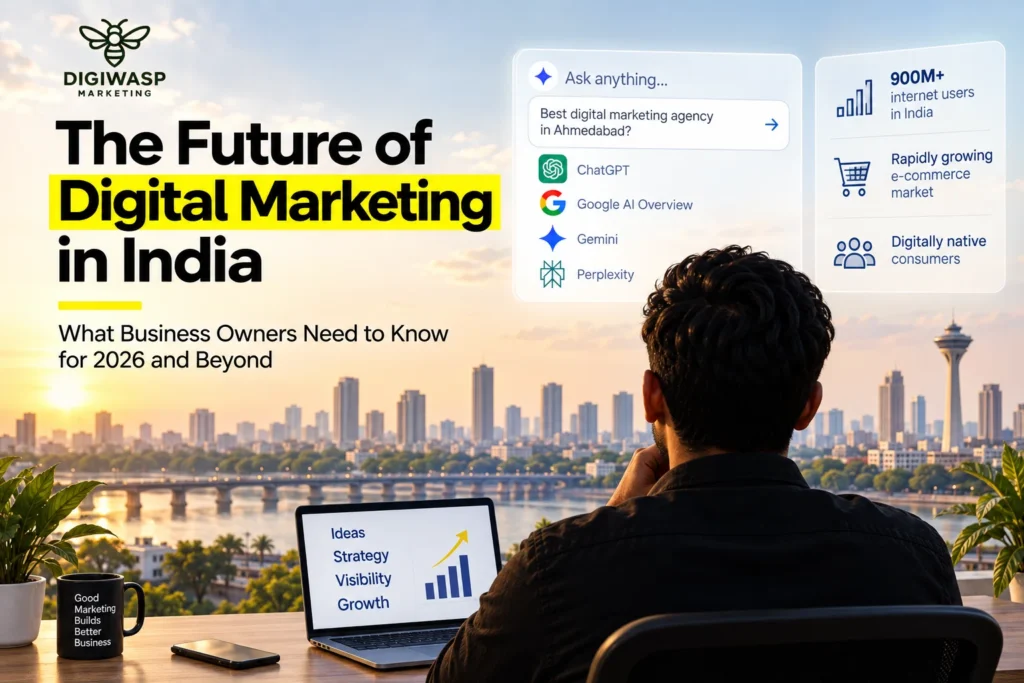
This is not a small, incremental shift. India now has over 900 million internet users, one of the fastest-growing e-commerce markets in the world, and a generation of digitally native consumers who make purchasing decisions almost entirely through online research, social proof, and AI-assisted discovery. Businesses that fail to understand and adapt to these shifts are not just missing minor optimisation opportunities — they are becoming structurally invisible to an increasingly large share of their potential customer base.
This article covers the specific shifts happening in Indian digital marketing right now, what they mean for businesses in Ahmedabad and across the country, and how to position your business to benefit from these changes rather than be left behind by them.
AI Is Changing How Customers Search — Not Just How Businesses Market
The most significant shift happening in 2026 is not a new social media platform or ad format. It is the rise of AI-powered search and answer engines — Google AI Overview, ChatGPT, Gemini, and Perplexity — as genuine discovery channels alongside traditional Google search.
Customers increasingly ask AI assistants direct questions instead of typing keywords into Google — “which digital marketing agency in Ahmedabad has the best reviews” or “how much does SEO cost for a small business in India.” These AI systems pull answers from indexed web content and cite specific sources. Businesses whose content is structured to be understood and cited by AI systems — through clear, direct answers, proper schema markup, and genuine topical authority — are beginning to capture visibility that traditional SEO alone does not provide.
This emerging discipline, often called Answer Engine Optimisation or AEO, is not replacing SEO. It works alongside it. The fundamentals — quality content, technical health, genuine authority — remain identical. What changes is the format. Content written to be extracted and cited by an AI system needs to answer specific questions directly and completely within the first few sentences, rather than building toward an answer gradually the way traditional blog writing often does.
Businesses that ignore this shift entirely are missing a rapidly growing discovery channel. Early data from markets where AI search adoption is more mature — the US and UK in particular — shows that AI Overview results are already displacing a meaningful percentage of traditional organic clicks for informational and comparison-style searches. India is following the same trajectory, just slightly behind. The businesses adapting their content strategy now, before AI search becomes the dominant discovery method, will have a significant head start over competitors who wait until it becomes unavoidable.
Practically, this means restructuring how content is written. Instead of long, meandering introductions before getting to the point, effective content in 2026 leads with direct, complete answers to specific questions, then expands into supporting detail. FAQ sections, structured data markup, and clear question-based subheadings are no longer optional extras — they are becoming core requirements for content that wants to be visible across both traditional and AI-powered search.
Video Content Continues to Dominate Organic Reach
Short-form video — Instagram Reels, YouTube Shorts — remains the single highest organic reach format available to Indian businesses in 2026. This is not a temporary trend that will fade once the novelty wears off. Platform algorithms across Instagram, Facebook, and YouTube consistently and deliberately favour video content because it keeps users engaged for longer periods than static posts — and engagement time is the primary metric these platforms optimise their algorithms around.
For businesses in Ahmedabad and across India, this means video cannot remain an afterthought in digital marketing strategy, treated as an occasional nice-to-have alongside a primarily static content calendar. Businesses producing consistent, quality short-form video content are building audience reach and brand recognition significantly faster than those relying primarily on static images and text posts — often by a factor of three to five times greater organic reach per piece of content.
The barrier to entry for video content has also dropped considerably. Businesses no longer need professional camera equipment or dedicated video editors to produce content that performs well. Smartphone cameras combined with accessible editing apps have made quality short-form video achievable for businesses of virtually any size and budget. The businesses that will struggle in 2026 are not the ones without video budgets — they are the ones without a video content strategy at all.
For different industries this plays out differently. A restaurant benefits enormously from quick preparation videos, ambient footage, and customer reaction content. A clinic or healthcare provider benefits from short educational explainers and behind-the-scenes content that builds trust and demystifies procedures. A B2B service business benefits from short expert insight videos and client testimonial clips. The format is universal, but the content strategy within it needs to reflect the specific audience and buying psychology of each industry.
Local SEO Is Becoming More Competitive and More Important Simultaneously
As more Indian businesses recognise the value of digital marketing, local search competition is intensifying rapidly — particularly in commercially active cities like Ahmedabad, Surat, and across Gujarat where entrepreneurial density is high and business formation continues to accelerate. Businesses that established strong Google Business Profiles, consistent local citations, and genuine review generation early are building a compounding advantage that becomes progressively harder for competitors to close.
This creates an interesting dynamic in 2026. Local SEO is simultaneously more important than ever — because local search intent converts at extremely high rates and represents some of the most valuable traffic any business can capture — and more competitive than ever, because the businesses that understood this early are now several years ahead in accumulated reviews, citations, and local authority.
For businesses that have not yet invested seriously in local SEO, 2026 represents a narrowing window rather than a closed door. The cost of building local search authority increases every year as competition grows, but it has not yet reached the level of saturation seen in more mature markets like the US or UK. Businesses starting now still have a meaningful opportunity to build competitive local visibility — but that opportunity shrinks with every year of delay.
The specific components of local SEO that matter most in 2026 have also evolved. Google Business Profile completeness and activity — including regular posts, updated photos, and prompt review responses — now carries meaningfully more ranking weight than it did even two years ago. Google has made clear through its algorithm updates that it rewards profiles demonstrating genuine, ongoing business activity over profiles that were set up once and left static.
Paid Advertising Costs Are Rising, Making Strategy More Important Than Budget
Across Google Ads and Meta Ads, average cost per click continues to rise year over year in most Indian markets as more businesses compete for the same advertising inventory. This is a direct consequence of increasing digital marketing adoption across the country — as more businesses recognise the value of paid advertising, the auction-based pricing model that underlies both platforms drives costs upward across virtually every industry and keyword category.
This rising cost environment makes campaign strategy — precise keyword targeting, strong ad copy, optimised landing pages, and continuous monitoring — more important than raw budget size. Businesses that simply increase ad spend without improving campaign quality are seeing diminishing returns, often spending significantly more to achieve the same or even worse results than they achieved with smaller, better-optimised budgets in previous years.
The businesses winning in this environment in 2026 are the ones treating paid advertising as a precision tool requiring genuine expertise, not a budget line item that scales automatically with more spending. This means rigorous keyword research to identify genuinely high-intent, lower-competition search terms rather than competing directly on the most obvious, most expensive keywords. It means investing meaningfully in landing page quality, since a well-converting landing page can offset rising click costs by converting a higher percentage of the traffic that does arrive. And it means continuous, disciplined campaign optimisation rather than a set-and-forget approach that was more forgiving when advertising inventory was less competitive.
For businesses in Ahmedabad and Gujarat specifically, this trend has a silver lining. Local and regional keyword competition remains meaningfully less saturated than national or metro-level competition in cities like Mumbai, Delhi, or Bangalore. Businesses willing to invest in precise local and hyper-local keyword targeting can still find genuinely cost-efficient advertising opportunities even as broader market costs rise.
Authenticity and Trust Signals Matter More Than Ever
Indian consumers in 2026 are significantly more sceptical of generic marketing claims than they were even two years ago. Years of exposure to inflated promises, fake reviews, and generic marketing language across every industry have made Indian consumers considerably more discerning about which businesses they choose to trust with their money.
Verified reviews, real case studies with specific data, transparent pricing, and genuine client testimonials are becoming essential trust signals — not optional extras that businesses can add later once they have more resources. Businesses that can demonstrate real, verifiable results consistently outperform those relying on vague claims and stock marketing language, even when the underlying product or service quality is comparable.
This shift rewards businesses willing to be transparent about their actual performance and honest about realistic timelines and outcomes. A business that publishes specific, verified case studies with real numbers builds significantly more trust than one making generic claims about being “the best” or “number one” without any supporting evidence. This is true across every industry — from digital marketing agencies to clinics to real estate firms to e-commerce brands.
This trend also extends to how businesses communicate about pricing and process. Consumers in 2026 respond more positively to businesses that are upfront about what something costs, how long it takes, and what realistic outcomes look like — even when that honesty means acknowledging limitations or setting more conservative expectations than a competitor promising unrealistic results.
The Consolidation of Digital Marketing Channels Into Integrated Systems
Perhaps the most important strategic shift for business owners to understand is that digital marketing in 2026 increasingly rewards integrated, multi-channel systems over isolated single-channel tactics. Businesses running SEO in isolation, without connecting it to their content strategy, their social media presence, and their paid advertising, are leaving significant performance on the table compared to businesses that treat these channels as one interconnected system.
A well-structured content article, for example, does not just serve SEO. It builds topical authority that supports rankings, provides material that can be repurposed into social media content, demonstrates expertise that builds trust for paid advertising landing pages, and creates the kind of specific, citable content that AI search systems favour. Businesses building each channel in isolation miss this compounding effect entirely.
This means the digital marketing strategies that will perform best through 2026 and beyond are not the ones chasing the newest individual tactic or platform feature. They are the ones building genuinely integrated systems where SEO, content, social media, and paid advertising reinforce and amplify each other consistently over time.
What This Means for Your Business in Ahmedabad
The businesses that will thrive through the rest of 2026 and into 2027 are the ones building genuine digital marketing systems — not chasing individual tactics in isolation. This means combining strong local SEO, consistent video content, honest and precisely targeted paid advertising, and content structured for both traditional search and emerging AI discovery channels into one coherent approach built around real business goals rather than marketing activity for its own sake.
The cost of waiting continues to grow every month. Every month a business delays serious investment in digital marketing is a month competitors spend building search authority, audience trust, and brand recognition that becomes progressively harder to catch up to. In a commercially dynamic market like Ahmedabad, where new businesses are forming constantly and competition for customer attention intensifies every year, this compounding disadvantage is genuinely significant.
The good news for businesses that have not yet invested seriously in digital marketing is that the opportunity has not closed — it has simply become more valuable to act on quickly. The specific shifts covered in this article — AI search, video-first content, intensifying local competition, rising paid advertising costs, and increasing demand for authenticity — are not obstacles. They are a roadmap for exactly what a business needs to prioritise to build genuine, sustainable digital growth in 2026 and beyond.
At Digiwasp Marketing we help businesses in Ahmedabad and across Gujarat build complete digital marketing systems designed for how customers actually search and discover businesses in 2026 — combining SEO, Google Ads, social media, and content strategy into one coherent, honest, results-focused approach.
📞 +91-8799196007
💬 WhatsApp Now
📧 contact@digiwaspmarketing.com
🌐 digiwaspmarketing.com

